About Maya Manthan
A Living Tradition of Shakti Upasana
Maya Manthan emerges from a living lineage of Shakti Upasana that has been preserved and practiced across generations.
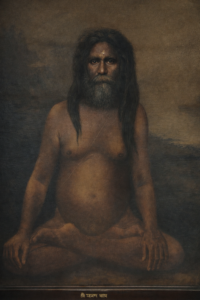
This lineage traces back to my great grandfather, Bipin Bihari, who received initiation from the Tantrik adept Ananda Rishi. Under his guidance, Bipin Bihari began the worship of Siddheswari, revered in the form of Krishna Kali—a rare synthesis of Kali and Krishna, representing the union of dissolution and consciousness, power and stillness.
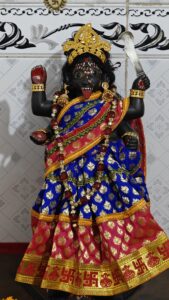
Krishna Kali is a rare and contemplative form of the Divine Mother, envisioned by the Tantrik adept Ananda Rishi as a synthesis of Kali and Krishna. In this form, the Goddess stands with her feet gracefully crossed like Krishna, symbolizing divine play (lila) within the cosmic dissolution represented by Kali. She holds the flute, expressing the call of divine consciousness and inner harmony, while also bearing the khadaga (sacred sword), representing the power that cuts through ignorance and illusion.
Krishna Kali embodies the union of tenderness and transcendence — the stillness of pure awareness alongside the dynamic force of transformation — revealing that creation, preservation, and dissolution arise from the same supreme Shakti.

During this period, Bipin Bihari also discovered an ancient idol of Dakshina Kali, buried beneath the cow-dung-laden earth of a nearby goshala. Recognizing its sacred presence, he installed and began worshipping the deity as Maran Barini, the one who liberates beyond the fear of death.
This idol was later identified as one of the fifty-one Kali idols historically gifted by Rai Ahalya Bai to fifty-one Brahmins, to ensure the continuity of Shakti worship. The same deity continues to be worshipped daily in our ancestral home in Kolkata, preserving an unbroken stream of devotion and practice.
Continuity and Evolution of the Tradition
The Tantrik foundation established by Ananda Rishi and Bipin Bihari was carried forward and deepened by my grandfather, Indu Bhushan, and later by my father, Archan Kumar, who integrated Advaitic understanding into the practice. This brought a refined balance between traditional Tantrik discipline and the direct experiential clarity of non-dual awareness.
Through this integration, the practice evolved not merely as ritual, but as a path of inner transformation—guided by awareness, discipline, and direct experience.
Carrying the Lineage Forward
I represent the fourth generation in this lineage of Shakti Upasakas.
Maya Manthan was established as a means to share these time-tested practices with sincerity and responsibility, making them accessible to modern seekers without diluting their depth or intent.
The focus remains on guided sadhana, disciplined practice, and direct inner inquiry—helping practitioners cultivate stability, awareness, and clarity in their own experience.
Maya Manthan is not an institution created for expansion, but a space created for continuity—where a living tradition is shared with those who are ready to engage with it sincerely.